Tuesday, August 2, 2011

City in a Day: Hannover

My going to Hannover was essentially the result of me finding myself with an empty Friday and grabbing for the closest city that looked interesting. Actually, I'd heard good things from other students and the Wikitravel website listed a bunch of helpful information, so I rode the trains for free (have I mentioned how much I love that? I love that) and arrived an hour and a half later.

I discovered a semi-underground shopping center ("The Promenade") which had a nice tea shop, and visited the nearby Tourist Information place. The helpful lady there answered my questions about the logistics of a few things I planned on doing, and gave me some brochures. One had a map, which was very useful because going out from the Hauptbahnhof you enter a tangle of modern streets crammed full of shops and people, and I got lost several times. Eventually, I made my way to the Market Church because I could see the steeple from the bahnhof and everyone knows I'm a sucker for churches.

Actually, it was your run-of-the-mill brick church, of which I'm starting to get very bored. I thought this was interesting, though--the above snapshots show a picture of the church after it was bombed during WWII, and how it looks today.

I've been spending too much time staring at old buildings, so I decided to walk to the lake because I heard you could ride a cruise around it. The day was overcast and a bit chilly, so the boat was fairly empty. There's not really a lot to see: it's a man-made lake in a park, so you'll see trees, people, and the top of buildings. Still, it was a nice change of pace.

Afterwards I got lost trying to find a museum and kept ending up at the Rathaus...
...Before realizing that the museum was right next door.

It's the August Kestner Museum and turned out to be free on Fridays, the day I was there. This is a good thing because besides saving money, everything is in German and I would not have have gotten my money's worth. There several exhibits on medieval stuff--writing, jewelry, cups, art, etc.
The Middle Ages: More Gangsta Than You.
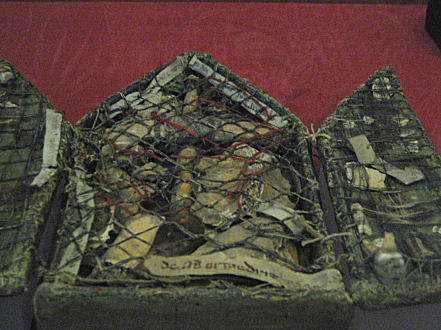
Also, there was a section on relics and stuff--I really wish I could've read the German! Can you spot anything remotely creepy in the relic-holding-case-thing?

There was, inexplicably, also an exhibit on some modern art/nouveau thing. It was strange, but am I the only one who wishes this really existed?

I knew that the museum had some ancient exhibits, and I was excited about the Greek and Egyptian stuff, but I was totally surprised by what came next:

A MUMMY. A REAL LIVE MUMMY. ACTUALLY A REAL DEAD MUMMY, BECAUSE THIS IS NOT A HORROR MOVIE.

I was a little excited about this.

There were actually two, and it was nigh impossible to get decent shots of either because the lights around kept reflecting off their protective cases. I wasn't able to find a lot of info about them online (because again with the no-reading-German), but if you'd like to try they were the Weibliche Mumie and the Mรคnnliche Mumie.

From there it was time for dinner, shopping (four week into my 5-week stay and I finally got a pocket dictionary), and the return trip. Last thing of note, though I unfortunately didn't get a picture of it: there was a McDonald's in the bahnhof, and it also advertised from from its McCafe, which everyone should already be familiar with.

This McCafe, though? Was a separate counter from the rest of Mickey D's with a glass case like a real cafe/bakery that sold cupcakes and muffins and stuff. WE NEED THIS IS AMERICA.

Monday, August 1, 2011

City in a Day: Schwerin

(So long as your day is only two and a half hours long)

For all of you who check every single day eagerly anticipating a new post (all one of you), I'm sorry. The last week has been so incredibly busy (travel- and school-wise) that I hadn't had the time to type anything.

As the title suggests, I was recently in Schwerin, a city in former East Germany. It has a lovely Altstadt (old town), but what my class was really there to see was the documentation center, a former Stasi prison. The Stasi, if you didn't know, were the state police in communist East Germany, sort of like a German KGB. They spied on you, kept documents on everything you did, and pulled you in here for months of psychological torture if they thought you had information they wanted.
 Cheerful place, right?
The prison part is tri-storied, with the first floor remaining in the style it was when the Nazis used the prison, the second floor styled after the Soviets who used it next, and the third floor after the Stasi. There's an empty cell on each floor showing how it looked, while other rooms have info about the people kept in that room, historical artifacts, or other information. Unfortunately, it's all in German.

As a documentation center, people can go in and apply to see their Stasi records.

We then headed to the Altstadt, and had very little time for sightseeing, so I didn't walk around the very big palace, though I did admire it up-close for a few minutes.
Is it just me, or am I seeing shades of Disney's Tangled around here?

We were informed that a particular cafe on the corner was very famous and very good, and so stopped there for a snack. It was middling--the Eis Schokolade that I ordered was 3-euro-something, and smaller than similarly-priced ones at other cafes in Lueneburg.
Still, though, it was chocolate, and that's what counts.

My last stop of the day before leaving was going to be the church. It's big and for a euro you can climb the stairs to see over the entire city. Unfortunately, it closed fifteen minutes before I arrived.
And the keyhole did not exactly reveal a lot.

I leave you with this, then, the picture of the tower I wanted to climb. There was still more to do in Schwerin, and I'm very sad that time constraints (it was, as earlier hinted, a class field trip) did not allow for a more thorough investigation. The palace, some museums, town tours, and more await the one who can spend more time than I there.

Saturday, July 23, 2011

The Language Problem

So I posted last week about how the language barrier often causes me panic and death spirals in the brain (non-scientific term). I thought I'd expound a bit on dealing with the language barrier, especially in a program that didn't require knowledge of said language.

When you're looking at study abroad programs, any good program will tell you what kind of language requirement they have, if there is one. This program specifically stated no knowledge was necessary (although individual courses, like the languages ones, had requirements depending on their level). But the thing to keep in mind is that is just the program.

Lueneburg is a moderately-sized city, I would say, and I rarely have a problem. If I didn't want to put out an effort, I could get through my entire five weeks using minimal German. I've been to all of one place (a small doner kebab joint) that didn't speak English, and as long as you keep your favorite stock phrase handy ("Sprechen Sie Englisch?") and point a lot if they don't, you're good.

But then, why are you here in the first place?
If this blog post were a movie, this would be where the camera gets shots of me from five different angles as the other characters realize what a profound statement I've uttered.

My German sucks. Two of my stock phrases (besides the aforementioned one) are "ich spreche nur ein bisschen Deutsch" and "mein Deutsch is sehr schlekt!" ("I speak only a little German" and "my German is very bad!" and if these are incorrect, well, that just shows how true it is.) These come in handy because when I'm faced with a rapid-fire spiel from a sales clerk, they're usually understanding if I don't respond in kind. And yeah, it's really handy to be able to ask if they speak English, whether you couple that with one of the other phrases or not. Sometimes I'm mentally exhausted and just cannot produce the brain power necessary for translating, and most of the time I don't know any words that would work.

Plus, and I'll admit it, there's a slight feeling of embarrassment when I'm doing the pidgin equivalent of German, fully knowledgeable of the fact that they're fluent in English.

Anyway: people are usually very understanding, though, when you make an effort despite being the worst person to ever try to learn German, ever. While in Celle, I went into a cafe/restaurant, and had a half-English/half-German conversation with the waitress, who told me my German was better than her English--it wasn't, but that was high praise in my book, especially because I was able to do more than just read things off a menu.

Friday morning, I missed the bus I wanted and had to hang around for half an hour until the next one came. Up came a little old lady who called some thing German. After asking her to repeat it, I was able to answer that today was Friday, not Thursday. For the next half hour, we had a conversation that covered everything from where I was from and why and how long I was in Lueneburg to something about how she doesn't (or isn't allowed to?) drive anymore, and she's going to get cat food for her cat (single, not multiple--I clarified. Also age 5), and the story of how she got said cat.

Did I understand all of it? No. I understood maybe a quarter--listening for keywords to get what she's actually saying, and then nonverbal communication makes up the rest of it. I could have used one of the stock phrases, but in the past few weeks I've learned enough that I can almost follow a very simplistic conversation. One of my goals was to improve my German, and so I'm making an effort to use it as much as possible, even though it's usually limited to basics like "yes," "please," and "excuse me."

Has having a tiny bit of German helped me? Definitely. The fact is I'm in another country, so if nothing else having a pocket dictionary to decipher signs would be nice, and having the basics definitely smooths things out. But a lack of language shouldn't deter someone, either. One of the other students in my beginning class knew absolutely NO German before coming here, none at all. Be realistic: it will make things more difficult (see again: being in another country) but it's doable. Learn your stock words and phrases, grab a pocket dictionary*, and get out there.

*Found in stores a lot here, they're about 9 euro and maybe 3 inches big. PERFECT.

Friday, July 22, 2011

Partial City in a Day: Lueneburg

Lueneburg is the city I'm currently living in. I've never heard of it being on the American tourist radar, but there is some stuff to do, as we discovered. Last Saturday, a group of us students had a day trip to Hannover planned. That was killed when this happened:
For reference, the bahnhof is about three times as crowded as it normally is. We have student passes that let us ride some of the trains within the state for free. These are what we were going to take, since train tickets can get expensive. The day before we planned to go, those trains went on strike. We showed up, only to have our train canceled. The next one and hour later? Also canceled. Faced with that, we decided to explore what we already had around us.

So, there's this tower that we kept seeing. It was visible from the walk to the bahnhof, and also from some of the bus routes.
Looks kinda cool, right? All I knew was that we called it the water tower. Well, we walk over, and it's a bit more impressive up close.
Much more impressive.

And yes, it basically looks like a rook from chess, or a tower without a castle. I don't remember the cost off the top of my head, but it wasn't too expensive--2 or 3 euro, I think, and we took an elevator to the top. On the floors immediately below the observation deck there were the remnants of some exhibits about water and ecology/nature, but they'd been mostly dismantled. The observation deck was wonderful, and I could have spent several hours up there.
Click to see bigger size in which details are actually visible.
You can see where the Altstadt stops and the rest of the city begins on the left. On the far right is Johanniskirche, St. John's Church, while behind it in the distance is Nicolaikirche. Middle-left in the distance you can just barely see Michaeliskirche (or just look below). The line of skinny buildings going diagonal across the center is Am Sande--yes, the city center is rectangular, rather than a square. The height also makes everything look much closer together than it is. I found it nigh impossible to pick out individual roads or squares, even big ones.

While you take an elevator up, you take stairs down when you leave the tower, and at one point you're walking (protected by railings) inside the giant metal basin that actually used to hold water. It's not very photogenic, but it is very cool. And slightly dizzying if you don't like heights.

After gathering, we remembered that it was Saturday and the farmer's market would be in front of the Rathouse (town hall), so that's where we went to lunch. Now despite great intentions, I haven't been to a U.S. farmer's market so I can't compare, but here a lot of produce is cheaper than the supermarket.

Michaelis (mee-ka-eh-lis) is the only one of the three big churches that I hadn't been to yet, so we made a pilgrimage. Being on the far side of the Altstadt, it's far away from the hustle and bustle of the shopping center; we wove through cobblestoned residential streets to reach it.
Also, please note that blue sky really does exist in Germany.
It's interesting to note that all three churches have different styles. Wikipedia calls Johanniskirche "Brick Gothic," which is shorthand for "Romanesque-esque and kinda ugly", Nicolaikirche is froo-froo Gothic, and Michaelis is between the two.

Inside is what you'd expect: ribbed vaults, tall pillars, etc. Interestingly, there is another sanctuary beneath the main one, much smaller.
There was a guide and an information desk at the back, but we didn't get time to poke around--they were setting up for an event or concert.
There's more to do, of course. There's a salt museum (salt was a big industry around here), more churches and historical buildings, a park, and undoubtedly more if I'd go to the tourist office and ask for info. The thing about living here, though, is that it feels like you've got it forever.

Monday, July 18, 2011

City in a Day: Celle

Our orientation booklet has a handy section on cities in the state, which we can reach by riding trains for free. One of these was Celle, which it described as a "well-preserved town...that presents a great impression of what the city used to look like in the 16th to 18th" centuries, as well as mentioning a castle. It was barely a hour away, so I hopped on the train to check it out.

The day I went I was running around and didn't have a lot of time to plot out a specific course of action. No problem, I thought. I know that it was a castle, a church, and a very nice old town, all of which should have signs pointing to them. Unfortunately, the signs were few and far between, so I just wandered aimlessly until I spotted steeples over the rooftops.

I did spot this a block away from the train station, though.

I finally found the castle--really, it's not hard to navigate around the town, I just followed the road signs for the "Altstadt" or the "Rathaus" (town hall)--and discovered that it's a more recent building than I was anticipating.


It's been converted into a museum--luckily for me, it was Friday which just happened to be their free day. Very few signs are in English, though. I could get the big picture of what purpose a room held, but smaller explanations of items and things weren't translated. All in all, I was in there for less than an hour.

They were also doing some renovations, thus the crane.

Surrounding the palace is a beautiful park, though. There's a lazy stream that runs through it with some gorgeous weeping willows on the banks, and even a playground. It's the perfect place to have a picnic.

The church looked like your average (pretty) town church from the outside, but inside it was a much more ornate style.
I also just realized I haven't shown any pictures of Germany with actual blue skies. They exist, I promise!
They had paintings of the apostles and all the prophets along the balcony, and some intricate carving heading the columns and around the arches.

Celle's Altstadt is pretty in a different way than Lueneburg. While L-town uses bricks, Celle has a lot of traditional houses in a different style.
A pretty one. Many building have painted decorations in addition.

The Altstadt is laid out mostly in a sensible grid, so it's easy to know where you are without a map. There are tons of cafes, bakeries, and shops. You can pick up a map from the Alteres Rathaus (old town hall, now tourist info),which includes a handy guide of historical places. Some (there are several museums I didn't get a chance to see, mainly because I lacked the desire to spend money) sounded good, but a lot are single places of interest, like this:
 This is the oldest house in Celle, now a clothing store. Most of the historical places in the Altstadt are like this. It's wonderful eye-candy.

Celle was fine for a day trip; I was done in about three hours, though I could've stayed longer if I visited museums or got something to eat (cultural problems: German places close EARLY, like by 6pm). It's close to Lueneburg, and so is easily done after classes. It's probably not the type of place you'd devote a whole day unless you planned out your itinerary ahead of time and knew all the things you wanted to hit.

Wednesday, July 13, 2011

Panic! At the Bakery

I'm a week and a half into my stay. I haven't been given a strict timeline for it, but our orientation booklet included a handy section on "transition trouble," which is given different names by different  psychologists/travel professionals/study abroad organizers but is generally as follows:
  1. Enchantment ("Everything is so new and charming!")
  2. Disenchantment ("Everything is so annoyingly different!")
  3. Retreat ("Everything I need and want is right here at home, I refuse everything else.")
  4. Adjustment ("I know I can't get everything out of one culture or another, each one has positives and negatives, and it's up to me which I choose to dwell upon.")
I keep waiting for stage 2 to hit me. I'm about a quarter of the way through, there are four stages, shouldn't I be hating everything by now?

Curse you, Germans, and your delicious bread!

Quite honestly, though, I seem to have skipped from Stage One to Stage Four With a Generous Helping of Panic. Which is to say, culturally everything is fine, but without being able to understand things, I tend to panic and then my mind goes into a death spiral.
I want to eat lunch at this cafe. Do I seat myself out here or go inside and order? If I seat myself, do I have a menu somewhere? If I go inside, can I eat here or do they expect me to leave? Can I sit by myself? As a single, am I supposed to share a table? Has my wallet fallen out of my bag since I had it five minutes ago? If I mess this up will I start a major international incident?
Then I took the bus home and got a sandwich from the closest bakery. I still made a fool of myself.

This is on top of the fact that while I actually know enough words to make myself understood (whether said words are gramatically correct or not), unless I have about five minutes beforehand to check every single syllable I want to use all German flees my head the minute someone talks to me, to the extent that I can't remember how to say "I only speak a little German."

Completely accurate representation of my reaction. I'm sorry, random German ladies who probably only wanted to know how late the market was open.

So technically, this might be Stage Three Fueled By a Complete Inability to Communicate Without Looking Idiotic Minus Any Resentment Toward This Culture.

Since I'm blogging this rather than, say, posting angsty Facebook status updates, you might assume I'll end by showing you how to not do this. Unfortunately, I haven't found a way to save my dignity, but a good plan is 1) having someone else with you, because everyone knows that group embarrassment is less embarrassing that individual embarrassment, and if dragging your roommate along with you at all times isn't your favorite idea, 2) just ask someone who knows. If not a local, then a student who's been here longer. So far they've all been good sports about it, probably because they've all been there at some point.

Tuesday, July 12, 2011

City in a Day: Bremen

Part of the USAC program includes a few field trips; on Saturday we went to Bremen. If the name sounds familiar to you, it may be because of the old folktale, The Bremen Town Musicians. Indeed, right off the main square of the Altstadt (old town) is a statue in honor of them, and you'll be able to find toys and souvenirs easily in their image. (Below: the official statue, and a lighthearted one near a living museum.)

Since this was a group trip, it had been arranged to meet with a tour guide to show us some of the Altstadt's highlights. We met in the main square in the shadow of this beauty.
St. Peter's Cathedral
Which also had two gorgeous mosaics in the tympana (singular: tympanum), the half-circle spaces above the door.

Have I mentioned that this entire trip is like a dream from my art history class?

Anyway, having a guide was a real treat, and if I go back I'll have to be sure to look things up ahead of time. Wandering around will only get you so far, and I would've missed things this:
The clock is a mosaic!
Every day on the hour from 12-14 (Germany generally goes by 24-hour time) the bells start playing, and the middle section of the round tower turns to reveal woodcuts of explorers and pilots. Apparently in the early 1900s a man purchased the alley, basically renovated it to how it looks now (traditional Hanseatic red bricks) and turned it into what's essentially a giant art gallery.
 Charles Lindbergh and the French welcoming him from his transatlantic flight

Being Europe, there are a fair amount of statues about, and of course you've got to have some in the art place. We were informed earlier that wherever was gold--shiny from rubbing--on statues was okay to touch.
I resisted.


We spent the rest of the day in the Schnoor, the city's oldest living quarters. I'm getting used to small, cobblestone streets, but these took the cake! At some points there was hardly room for two people to pass each other.

People live there, yes, but it's also a bustling hub close to the river and filled with cafes and restaurants, shops selling stuff besides your usual tourist swag, and what they claim is the world's smallest hotel (it fits two people).

Sadly, we had to be back on a train that evening and didn't get to see nearly enough, but since I can ride the trains free with my student card and ID, I'll have to go back at least once. Speaking of trains:
Even the bahnhof is gorgeous!

LinkWithin

Related Posts Plugin for WordPress, Blogger...